Nella reveals Andrea’s second relationship
The Lying Life of AdultsNella reveals Andrea’s second relationship during a Sunday lunch, when Giovanna asks about a white-gold bracelet passed through the adults’ tangled relationships. The disclosure, made in front of their daughter after Andrea refuses to answer, turns an object and a chain of evasions into a blunt account of a marriage divided by long-standing secrets. Its immediate effect is not reconciliation but a further retreat into silence: Andrea leaves the table, and Nella’s attempt to speak the truth is followed by her own desperate denial.
Causes and Background
The revelation follows a period in which Giovanna has struggled to understand the rupture between her parents and their friends. She has seen her mother and Mariano exchange glances and words that seemed to carry a meaning concealed from the rest of the family. Later, she imagines that her aunt Vittoria may have relayed what Giovanna told her, and that this information set off the violent confrontation between Andrea and Mariano. These remain Giovanna’s anxious explanations rather than confirmed facts; the adults have not given her a clear account of what happened.
The bracelet becomes one of the few tangible clues. After the confrontation, Costanza visits Giovanna and helps put the white-gold bracelet on her wrist, though Giovanna’s mother explains that it is a restitution, not a gift. Giovanna knows the adults’ glances and gestures around it signify more than she can articulate. She wears it day and night, carrying an unresolved family history on her wrist. At lunch, she finally asks Andrea whether Vittoria gave it to her. His qualified answer—that in a certain sense she did—makes the object a way into the question he has avoided.
The Disclosure at Lunch
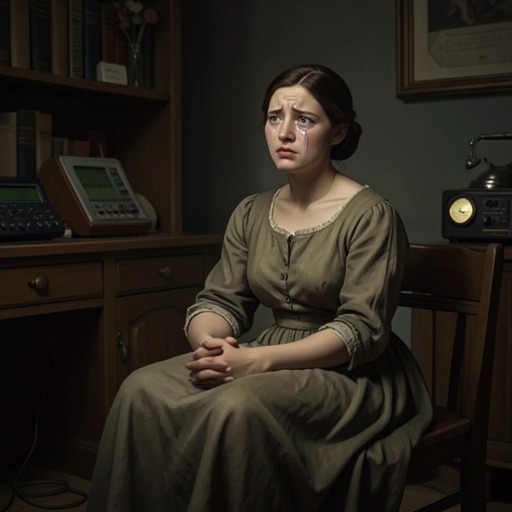
Giovanna asks why Andrea gave the bracelet to Costanza. He raises his eyes and stares at her coldly but does not answer. Nella orders him to respond; when he remains silent, she blurts out that he has had another wife for fifteen years. Her words expose the duration of Andrea’s other relationship and recast the adults’ strained behavior as part of a private history rather than a dispute that Giovanna can explain away as politics or friendship.
The scene is shaped by the mismatch between revelation and response. Nella speaks as if the truth has escaped her in the heat of the moment, and immediately seems to regret having disclosed it. Giovanna, however, is not surprised. She feels for an instant that she has always known, and treats the information less as a moral shock than as something that might be accommodated: if the arrangement had lasted fifteen years, she thinks, perhaps the family could accept it and regain peace. Her response registers how long she has lived among hints without being told their meaning.
Nella’s Denial and Andrea’s Withdrawal
Trying to make the adults’ situation symmetrical and therefore bearable, Giovanna tells Nella that she, too, has another husband. Nella turns pale and insists that she does not. The contrast between her abrupt disclosure of Andrea’s secret and her vehement denial of a corresponding relationship unsettles Giovanna’s attempt to make the situation fit a pattern she can manage. Rather than stabilizing the family, the exchange reveals how little Giovanna can safely infer from what she has witnessed.
Giovanna laughs involuntarily at Nella’s repeated assurance. She sees anger in Andrea’s eyes and feels ashamed, but cannot undo the laugh; it settles into a fixed smile. Andrea then rises slowly and says he is going to sleep. It is two in the afternoon, when he would ordinarily shut himself away to study until dinner. Nella says she will come too, but Andrea shakes his head. The familiar act of lying down together has, in that moment, become intolerable to him.
The Ending and Its Significance
Before leaving the kitchen, Andrea tells Giovanna that nothing can be done about it: she really is like his sister, Vittoria. The remark links the family’s marital crisis to the resemblance that has shaped Giovanna’s sense of herself. Earlier, at twelve, she overheard her father say that adolescence had nothing to do with her school difficulties and that she was getting Vittoria’s face. She understood the comparison through the ugliness and spite he had long associated with his sister. Now, at the close of the lunch, the same resemblance returns as Andrea abandons his usual reserve and withdraws from Nella.
The disclosure therefore answers one question while leaving the larger emotional pattern unresolved. Andrea’s other relationship is no longer merely an inference Giovanna makes from the bracelet and the adults’ conduct; Nella states its duration in the family’s hearing. Yet the scene offers no account of the other wife, no reconciliation, and no explanation of all the events that preceded it. Instead, it ends with a changed household intimacy and Andrea’s painful identification of his daughter with Vittoria. The truth enters the family as speech, but it does not restore trust or make the family legible to Giovanna.